SPARCstation 1
Introduction
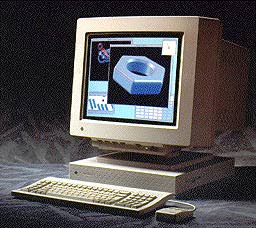
 The SPARCstation 1 (codename “Campus”), or Sun 4/60, was marketed by Sun
Microsystems from April 1989. It is first and foremost the first
workstation to integrate the powerful SPARC processor in a “Desktop”
format.
The SPARCstation 1 (codename “Campus”), or Sun 4/60, was marketed by Sun
Microsystems from April 1989. It is first and foremost the first
workstation to integrate the powerful SPARC processor in a “Desktop”
format.Originally sold for between $9,000 and $20,000, it was intended to seriously compete with the high-end PCs and Macs of the time, while offering a new case format, called “Pizza box” (by obvious analogy, given its dimensions, with the famous cardboard pizza box), measuring 40.5 cm x 40.5 cm for a mere 7 cm of height.
Hardware
Based on the SPARC architecture (Scalable Processor ARChitecture), a standard built on a RISC model (Reduced Instruction Set Computer), the SPARCstation 1 is based on an LSI Logic processor clocked at 20 MHz combined with a FPU coprocessor (Floating Point Unit) Weitek 3167 (or 3170). These processors were introduced in 1987 by Sun to replace the Motorola 68020 and 68030 that then equipped their workstations.
It should be noted that Sun released in 1990 a facelift of the SPARCstation, named quite simply SPARCstation+1 and having a faster computing unit, equipped with a 25 MHz LSI Logic processor and the Weitek 3172 coprocessor.
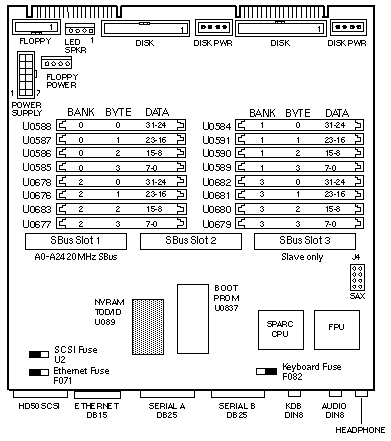
This machine inaugurates the series of sun4c architectures. The motherboard offers 3 SBus ports for expansion cards (replacing the VME buses), 8 kHz audio, two serial ports in DB25 format, an AUI port for the network and a SCSI connector (which notably makes it possible to use an external CD-ROM drive). It also integrates 30 memory slots, grouped by 4, allowing up to 64 MB of RAM in SIMM format. The case can hold 2 drives in SCSI-2 (50 pins), an appreciable luxury given its reduced size, as well as the motorised-eject floppy disk drive.The basic graphics card can display 256 colours at 1152×900, with correct performance for the time.
The main problem with these machines today remains their NVRAM, a small component capable of saving the OpenBoot data (the equivalent of the PC BIOS) as well as the system time, which is reaching the end of its life.
It is nevertheless possible to replace it fairly easily with an equivalent component, which I did for the machine I own.
Software
The machine runs by default under SunOS 4.0.3, but Solaris up to version 7 can be used.
Linux and OpenBSD are also supported.It should nevertheless be realised that the limited power of the machine is a brake on the use of modern OSes (OpenBSD 3.8 takes more than 3 minutes to boot on mine, yet well equipped).
Conclusion
The SPARCstation 1 therefore offers complete, sturdy and well-integrated hardware, which makes it possible to still enjoy today systems such as SunOS 4 that now belong to another age.
Sources :
en.wikipedia.org/wiki/SPARCstation_1
neriki.free.fr/sparcstation.html
www.mo5.com/musee/fiche.php?id=sparcstation1
www.ice.mtu.edu/~jamyles/docs/fe/docs/wcd00007/wcd00734.htmby Cédric TESSIER on